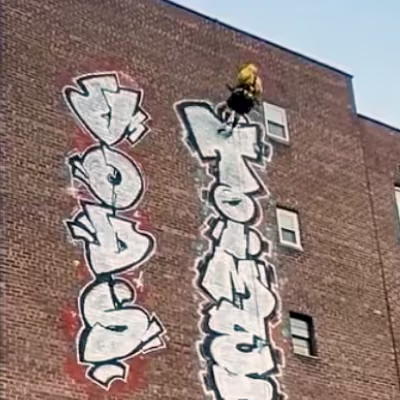
Graffiti Towers Cleanup Begins
Crews have started cleaning the notorious graffiti towers. The new owners ... Read More
This store requires javascript to be enabled for some features to work correctly.


All You Need To Succeed In
Graffiti Removal & Surface Protection


How to remove paint, including graffiti and overspray, paint spills, line stripes, curb markings, glyphs, and tags from concrete and asphalt is one of the most commonly asked graffiti removal questions. We have tried to address all of these jobs with the advice below. Continue reading to discover which product is best for your project.
To remove graffiti and overspray from concrete or block walls, use our Bare Brick, Stone & Masonry Graffiti Remover (BBSM).
For typical graffiti, apply three flood coats, with approximately 3-minute intervals between coats. Wait a few more minutes after the final coat before rinsing with a small pressure washer.


Agitation while applying this product can greatly assist in the removal process. Experience with the product will help users judge how much dwell time and how many applications are required for different surfaces and particular spray paints.
Patience is especially important with older or thicker graffiti. Keep the graffiti wet with the product for as long as practical before rinsing.


For certain inks, dyes, and specific spray paints—especially reds— Feltpen Fadeout may be necessary to achieve quick and flawless results.

Learn how to help prevent shadows on porous surfaces and treat remaining traces of graffiti.
Read more →Please refer to our Technical Data Sheets (TDS) for more detailed instructions, or contact us for expert advice before starting your job.
As a general rule in paint removal, we recommend using a thicker remover for thick paints and a thinner remover for thin paints, including spray paint, that can penetrate porous substrates and dissolve the paint from the front as well as from behind.
To remove spray paint, latex, acrylic, and overspray, you can use either Bare Brick, Stone & Masonry Graffiti Remover or Vanish Graffiti & Paint Remover . Extra coats and/or extended dwell times may be needed on thicker or older paints.
For thicker, dried paint, paint spills, or line stripes on concrete, we typically use Transgel Paint & Graffiti Remover . It can be applied by brush, broom, or airless paint sprayer.
Apply Transgel thickly and leave it on for as long as needed. Dwell time may range from approximately 30 minutes to several hours, or even overnight, before rinsing with a pressure washer. For larger jobs involving thick or older paint, a hot-water pressure washer can be extremely beneficial.


Apply Transgel thickly or, alternatively, apply Vanish several times using a soft nylon broom and agitate as you apply. Allow the remover to dwell for as long as needed, then rinse with a pressure washer.
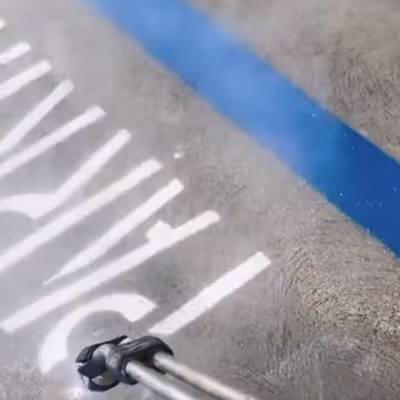
Transgel Paint & Graffiti Remover has proven highly effective at removing line stripes from asphalt and concrete. We have seen it used to remove miles of roadway striping, as well as painted lines and markings in concrete parking structures.
Typically, Transgel is applied by brush or sprayed with an airless paint sprayer and left to dwell for as long as needed before rinsing with a pressure washer.
Vanish Paint & Graffiti Remover can be especially helpful for removing thinner remnants of paint, particularly around mortar joints, natural stone, and exposed aggregate surfaces.
In many cases, using both Transgel and Vanish produces the best results. Transgel can remove thicker layers while Vanish helps dissolve thinner remnants in joints, pores, and other difficult areas.
Occasionally, when cleaning concrete, an acidic cleaner may be needed for the final removal of mineral stains, including titanium dioxide staining, left after using paint-removal products.
When removing typical spray-paint graffiti, road markings, or glyphs from asphalt, Bare Brick, Stone & Masonry Graffiti Remover can be broomed onto the road surface in three coats at approximately 3-minute intervals and then rinsed with a pressure washer.


Asphalt, or tarmac, consists of bituminous binder and aggregate. When aggregate is mixed with hot asphalt cement, the surface appears black. As asphalt ages and oxidizes, the coating over the aggregate gradually breaks down, revealing more of the underlying stone. This can give older asphalt a gray appearance.
On many older road surfaces, Bare Brick, Stone & Masonry Graffiti Remover can be used without visible signs of surface damage or degradation.
For this reason, we often recommend Transgel Paint & Graffiti Remover . Transgel is pH neutral and can generally be left on longer while minimizing degradation of the asphalt binder.
Apply Transgel thickly by brush or airless sprayer and allow it to dwell for approximately 10–30 minutes or longer as needed before pressure washing.


Transgel has also proven highly effective on dried, thicker, older white, pale-blue, and yellow spray paints on asphalt. It can be left in place as needed to wrinkle and soften the paint before removal with a pressure washer.
For larger jobs, another option may be to cover remaining graffiti with compatible black road paint rather than removing every trace.


After removing graffiti from the sound wall, this city chose to paint over the graffiti remaining on the asphalt road.
To remove thicker paint from asphalt, including paint spills and line stripes, apply Transgel Paint & Graffiti Remover thickly and allow it to dwell for as long as necessary.


For larger removal jobs or older, thicker paint, a hot-water pressure washer can be extremely useful.
When dealing with paint spills, first remove any thick or still-wet paint with scrapers, rags, or similar tools. Avoid pressure washing wet latex paint, as this can spread a relatively small spill over a much larger area.


Latex paint pens and spills are commonly encountered on driveways and roads. In some cases, a rotating pressure-washer nozzle combined with hot water can efficiently remove large areas of latex, emulsion, or acrylic paint.
Hot water under pressure can also be extremely useful for removing graffiti made with acrylic or oil-based paint pens, particularly after the paint has first been softened with the appropriate remover.
Products mentioned in this article, including related graffiti removal products, tools, and surface protection solutions.

$21.30
View More
$27.75
View More
$27.75
View More
$120.00
View More
$425.00
View More
$112.00
View More
$26.50
View More